Teach Your Children Well about Climate Change with Guest Harriet Shugarman-Founder of Climate Mama

We are all anxious about world events and particularly to the degradation of the environment. The term eco-anxiety, includes “worry, fear, anger, grief, despair, guilt, and shame, as well as hope. A recent BBC Newsround survey found that 70% of 8- to 16-year-olds report feeling worried about the state of the planet. So how do parents, caregivers and teachers talk to kids about climate change? What can we tell them that will ease their tension about the climate crisis? We discuss these issues with our guest and friend of the podcast Harriet Shugarman, an incredible woman who is working to put children’s minds at ease. Harriet wrote the book, How to Talk to Your Kids About Climate Change:Turning Angst into Action, which provides tools and strategies for parents to explain the climate emergency to their children and galvanize positive action. Check out these websites for more info:

Our Kids Climate https://ourkidsclimate.org/

Parents for Future Global  https://parentsforfuture.org/

How to Talk to Your Kids About Climate Change, Turning Angst into Action. https://www.amazon.com/Talk-Your-About-Climate-Change/dp/0865719365/ref=sr_1_2?keywords=anthropocene&qid=1570739365&s=books&sr=1-2

Global Warming Six Americas, Yale Climate Communications https://climatecommunication.yale.edu/about/projects/global-warmings-six-americas/

You can find The Many Shades of Green podcast on all major podcast apps (Spotify, Apple, iHeart, Amazon and more) Also check out HudsonRiverRadio.com and Malcolmpresents.com #RaiseYourEcoConsciousness

New Castle Healthy Yards Native Plants with Rene Artale and Karen Bazik

 Our guests this week  Rene Artale, Karen Bazik  Leadership Team Members at NC Healthy Yards on Native Plants are forging the movement for more gardens, meadows, native plants and trees, and less lawn.  We talk about the importance of native plants, one of which is poison ivy, which is beneficial to the ecosystem, but not to humans… think rash. There are other wonderful native plants that can make your land both beautiful and eco friendly (Summersweet; highbush blueberry, packera auera, coral honeysuckle   Leucothoe – provides 4 season appeal, Fringe Tree, and Oak trees to name a few. Other tips, don’t use leaf blowers or pesticides and plant original species that keep your land sustainable. Gardens and Meadows are beautiful and are more beneficial to Earth’s creatures and they create pollinator pathways. For more info follow New Castle Healthy Yards on FaceBook and email them at nchealthyyards@gmail.com. For past shows go to hudsonriverradio.com, malcolmpresents.com. Subscribe to The Many Shades of Green Podcast and tune in on Spotify, Apple, Google Play Spreaker, and ask Siri or Alexa to play our podcast. #RaiseYourEcoConsciousness

Listen to “Rene Artale and Karen Bazik, Leadership Team Members at New Castle Healthy Yards” on Spreaker.

Are we all EcoSexuals? Guests Annie Sprinkle and Beth Stephens give us insight into the field of Ecosexolgy

In this episode, we will explore the Ecosexuality movement, a relatively new sexual identity which connects environmental activism based around nature, and promotes the idea of the earth as a lover. It invites people to treat the earth with love rather than see it as an infinite resource to exploit. It was founded by our guests, Elizabeth Stephens and Annie Sprinkle, who describe themselves as “two ecosexual artists-in-love”, whose manifesto is to make environmental activism “more sexy, fun, and diverse”. Their new book, is titled, Assuming the Ecosexual Position: The Earth as Lover. Annie and Beth give us insight about how they came together to collaborate on this latest work, how they took a stand against homophobia, xenophobia, and how this union led to the miraculous conception of the Love Art Laboratory.

Check out their new book Assuming the Ecosexual Position:The Earth As Lover
https://www.upress.umn.edu/book-division/collections/arts-humanities-2021
  and go to sprinklestephens.org to get more about the EcoSexual movement and films Water Makes Us Wet and Goodbye Gauley Mountain. For past shows go to hudsonriverradio.com and malcolmpresents.com. Follow us on FaceBook and Instagram, tweet us @tmshadesofgreen. A shout out to my Green Diva Sistas at thegreendivas.com

Listen to “Annie Sprinkle & Beth Stephens and The Eco Sexual Movement” on Spreaker.

Which of these world leaders Al Gore, Hillary Clinton, Mikhail Gorbachev, called our guest Lianne Sorkin a Goddess? The Answer is in the listening.

Lianne Sorkin has traveled the world and has taken action to create solutions to climate change, social justice and violence against women. She has over 40 years experience as a live and virtual event executive producer, meeting facilitator and international project manager for the United Nations. She has lived in Japan, and is fluent in Japanese, and was the UN’s liaison for the Secretary General of the 4th World Women’s Conference in Beijing to the First Ladies, including Hillary Clinton. Lianne works with Project Drawdown, Pachamama Alliance, and the UN Trust Fund to End Violence Against Women. For more info go to drawdown.org, pachamama.org, 350NYC.org and HudsonRiverRadio.com

Listen to “The Many Shades of Green” on Spreaker.

1813 Slow and Sustainable Fashion

1804 Before the Flood with Green Dude Fisher Stevens talking about Climate Change and Leonardo DiCaprio

This episode of Green Dudes features Fisher Stevens, Academy Award winner for the documentary film, The Cove, and a wonderful actor and activist. He directed the Eco-documentary, Before the Flood, which follows Leonardo DiCaprio as he meets with activists, scientists and world leaders to discuss the dangers of climate change and possible solutions. Green Diva Meg chats with Fisher about the film. I met Fisher Stevens at a screening of the documentary at the Jacob Burns Film Center in Pleasantville, NY, and we talked about the movie, and briefly discussed how important it is to get the message out to all Earthlings, that we must be proactive in pushing forward ideas and solutions, to make the planet a cleaner and healthier place to live. For more info go to beforetheflood.comthegreendivas.com, tweet us @50ShadesofGDs, @TheGreenDivas, @tmshadesofgreen, @BeforeTheFlood_        #BeforeTheFlood


1719 Merry Merry and Small Victories

Saying farewell to 2017 in our year end show. It’s been a tough year, yet it had positive moments. Dedicating the good things in life, in honor of my brother Mitch, who passed away during the Thanksgiving holiday. He will be greatly missed. His music and art will fill the universe forever.

With all the tumult, we have had many Small Victories, and with the help of Stephanie Palumbo and Alison Diviney, we will learn about more Small Victories in the coming year. Go to celebratesmallvictories.com, thetokens.com and thegreendivas.com for more info.

Green Diva Meg and I (Green Diva Max) wish everyone a  Merry, Merry and a Happy, Healthy New Year!


#1701 Why We March, Pink Hats and Big Hearts

#1701 Why WE March

We turned pink for this episode of 50 Shades of Green Divas, as Green Diva Meg (who also knitted the p-hats) reports from the Women’s March in Pompton Plains, NJ. It was a monumental display of activism, as millions of women and men took to the streets across America and across the globe, to partake in this most historic event, to raise awareness of the need to protect and love one another, and stand up for equality and social justice for all. Feminist icon Gloria Steinem spoke to the crowd in Washington, DC and said “make sure you introduce yourselves to each other and decide what we’re going to do tomorrow, and tomorrow, and tomorrow. We’re never turning back!” We need to keep our collective boots on the ground and not let up for a minute. Mr. Trump will hear us, and we will get under his skin. Keep the faith, and keep on fighting!


What’s the Tipping Point for Our Mess

By Susan Lutz

A growing problem in the United Kingdom, and worldwide, is what is called fly-tipping. The intriguing name drew me into the video. Clip after clip showed cars pulling up to spots around the U.K. and dumping their trash, couches, plastic roofing, recycling, and one group of people even dumped dead sheep. All the mess, stink, and trouble left for someone else to clean up. After seeing the video, I felt I’d tipped, as if it was one too many videos about terrible things we’re doing.

I want to care about all our troubles. The disturbing election in the U.S., the terrorist attacks, the rape victims, the dolphins slaughtered and captured, the sharks butchered for their fins, the children taken from their families. After so much, I feel numb, no longer seeing, or feeling, the pain. I only look, a voyeur just scrolling by.

The heavy load of the constant barrage of information weighs me down. Though, it’s not visible on the outside, on the inside, I think my soul is suffering from so much “much.”  The fact that people are dumping trash on other people’s property and country roads and national lands enrages me. I want to scream, donate money, judge, yet, where do I go with that anger? I find myself lost. I feel the whole grow bigger.

I remember those campaigns against littering in the 70s. The roads were dotted with trash, cigarette butts, everything we could toss out a car window or discard while walking. Then, we rallied, we educated, we recycled, and now we find we’re fly-tipping? Letting others take care of our problems passes the buck to no end. There might not be a difference in fly-tipping and creating little plastic coffee cups by the billions to pollute the land for a one-time thrill. The consciousness behind all these acts is meant to quickly satisfy and satiate- to not take responsibility for our choices.

When I lived in Central America, I often heard tourists or expats talking to each other about the shameful way the citizens polluted their lands. Yet, everyday I saw hard working men and women sweeping the streets, earning probably less than $400 a month trying to change things, keeping the land clean. I saw things change. I see them change here too. Then, I see on-line what seems to be this unearthing of non-stop hideous behavior of people hurting each other and the environment. I needed to ask: why keep looking? Is it ever going to change?

I look because in the mess of our humanity, I see warriors of peace, love, kindness, and smarts, all trying to make the world a better place. Just recently, I read France will be banning plastic cutlery, “to promote a ‘circular economy’ of waste disposal, ‘from product design to recycling…’” A rescue organization in India finds desperate animals in dire condition in the street. In a few moments, I can see a transformation from near death to salvation – this with the power of social media.

There’s good out there, a lot. There’s bad too. Staring at it, looking for too long takes away the time we have in front of us to take responsibility for the little and big issues we all face. By keeping our heads tucked deep into our phones and feeds and likes, we miss the opportunity to create a connection standing, sitting, flying, flapping, or wagging right in front of us. I’m the first to raise my hand and say I am guilty of too much. I’ve even wondered if the beeper wasn’t such a bad idea. The number came up, we had time to look, find a quarter, a phone….all that time….all that time to think about what we were doing.




#1616: Anti-Poaching Game Changers

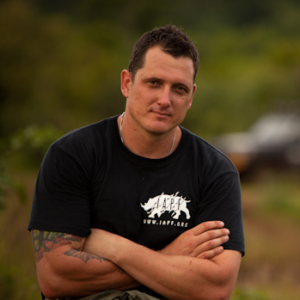
damien_profile“Green” eco-warriors are working to protect rhinos and elephants, which are on the verge of extinction, as they are killed by poachers for their horns and tusks. My guest this week, Damien Mander, founder of the International Anti-Poaching Foundation, is working to train rangers in the preserves of Africa, via legal and direct tactics, to bring poachers to justice. He is a vegan and believes that animals suffer tremendously when they are raised for consumption, which is also a major contributor to climate change. Damien is starring in a James Cameron film called “The Game Changers”, which you can check out by going to gamechangers.com. For more information on the work of the International Anti-Poaching Foundation, go to iapf.org
[soundcloud url=”https://api.soundcloud.com/tracks/282472207″ params=”color=ff5500&auto_play=false&hide_related=false&show_comments=true&show_user=true&show_reposts=false” width=”100%” height=”166″ iframe=”true” /]

Annihilation of Nature

“The main purpose of this piece is to bring to light the many animal extinctions taking place on Earth.”

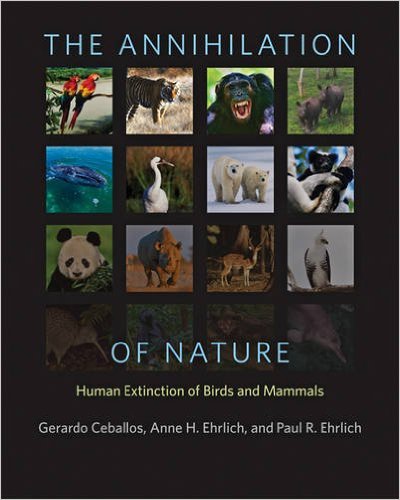
First, the authors set the scene by describing Earth’s relationship with the universe and then illustrating the history of life on Earth, dating back to one billion years ago. They provide a brief history of humans (Homo sapiens), which especially focuses on the different industrialization eras that took place around the world. Eventually, the book catches up51603hN9yuL._SX398_BO1,204,203,200_ to the present as they contemplate the extinction of modern animals. After spending much time analyzing the extinction of many birds and mammals, the autho
rs discuss the significance of these extinctions. The main purpose of this piece is to bring to light the many animal extinctions taking place on Earth. A handful of solutions are proposed in the final pages of the book.

Several different literary (as well as visual) techniques were used throughout the book, some good, others less effective. Most notably, there were over one hundred photos of wildlife included in the book. The pictures carried great significance and made the text more powerful. However, the few pages that were without any photos were nearly unbearable, as the large chunks of text were quite overwhelming. Even so, the book included important facts on animal extinction when necessary, which proved to be effective. Furthermore, the description of wildlife tragedies were especially influential For example: In [the whale’s] stomach it had a golf ball, surgical gloves, duct tape, miscellaneous plastic fragments, a pair of sweatpants, and twenty plastic bags, among other trash. Plastic cannot be digested and simply clogs the gut, causing death not directly but indirectly, through starvation and disease.” (83) This graphic description leaves readers with a vivid, powerful image and a lasting impression. On another note, I began to notice awkward wording in a handful of instances. For example, the author refers to the Bonobo species as “our sexy living relatives.” Additionally, sometimes the authors seemed to demonize the human race as a whole, rather than pointing out a specific group responsible for poor environmentally sound decisions. Ultimately, the authors make powerful use of certain techniques to illustrate the sad stories of extinction throughout history.

This piece was certainly successful in providing readers with an above average understanding of bird and mammal extinction. I learned many different things, ranging from the importance of biodiversity in the Amazon rainforest to the illegal hunting of elephants for the ivory trade. The use of photography amidst well-written, evocative text throughout the book created an inviting environment to learn and sympathize.

WECAN: Women’s Earth & Climate Action Network

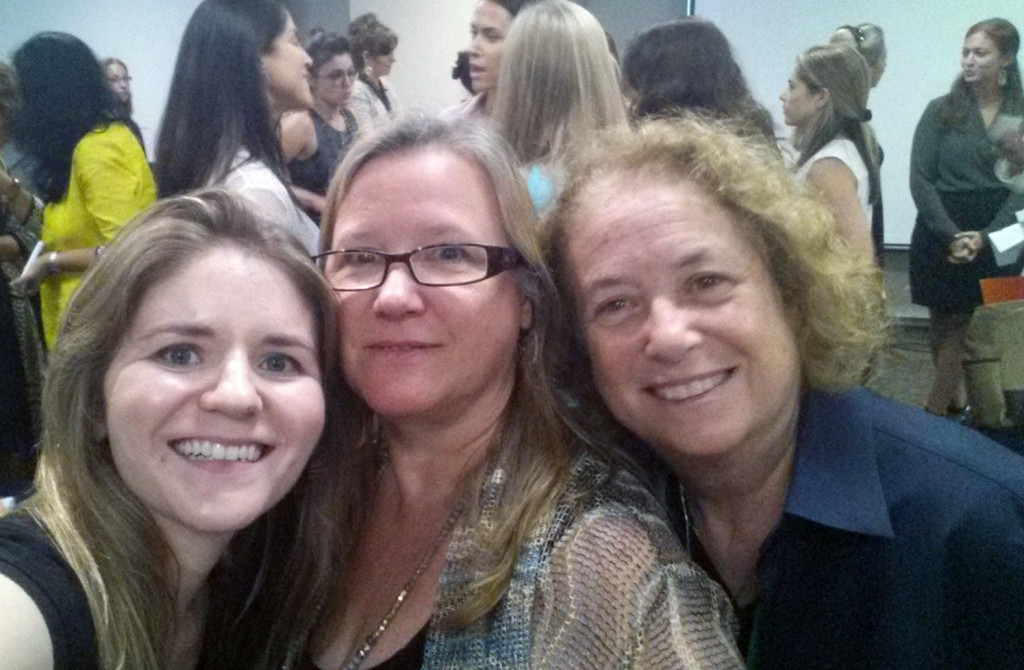
Maxine-Abba-Meg_2This weeks episode takes us to the Global Women’s Climate Justice Day of Action at the UN, sponsored by the Women’s Earth and Climate Action Network (WECAN). This event was attended by women from over 50 countries. To have such a collection of amazing women in one place, who presented stories of courage and resilience in combating climate change was deeply touching. Women play a key role in adapting solutions to climate change, and it was an honor to speak with WECAN founder Osprey Lake, environmentalist visionary Sally Ranney, as well as Neha Misra founder of Solar Sister, Harriet Shugarman Executive Director of ClimateMama, Executive Director of CELF Katie Ginsberg and student Coreena, and Patricia Gualinga-Montalvo, Indigenous Leader of Ecuador, whose interview was translated by Amazon Watch’s Executive Director Leila Salazar-López. For more information visit wecaninternational.org


[soundcloud url=”https://api.soundcloud.com/tracks/237134561″ params=”color=ff5500&auto_play=false&hide_related=false&show_comments=true&show_user=true&show_reposts=false” width=”100%” height=”166″ iframe=”true” /]